Kodak Pixpro Astro Zoom Az251-sl 16mp Digital Camera With 25x Optical Zoom and 3 Lcd Reviews
Introduction
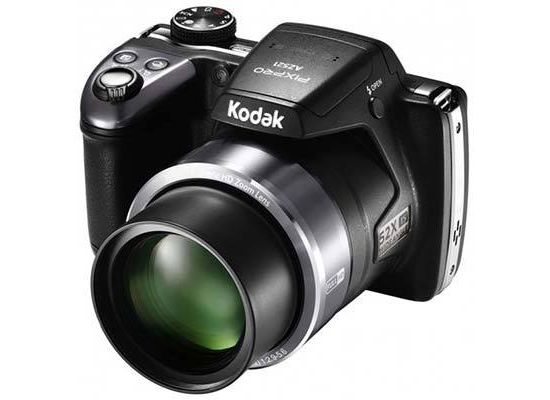
The Kodak PixPro AZ521 is a new super-zoom camera, offering a massive 52x lens with an effective focal length of 24-1248mm. Other standout features of the range-topping Kodak AZ521 include Full 1080p Hard disk video, a 3-inch rear LCD screen, 16.79 behind-illuminated ane/two.3-inch CMOS sensor, 360-caste panoramic shooting and an ISO range that stretches from ISO100 to ISO3200. The Kodak PixPro AZ521 is very competitively priced at £199 in the United kingdom, and is only available from Argos and Tesco. Made nether license past JK Imaging, does this new Kodak photographic camera live up to its heritage? Carry on reading our Kodak PixPro AZ521 review to notice out...
Ease of Utilise
And then is Kodak back making cameras again? Not exactly, for the AZ521 super zoom/ span photographic camera is i of the outset such branded models created under license past JK Imaging, which sources its product from China, and too tells us Kodak all the same officially has a hand in overseeing its creations.
Outwardly though it'southward business concern as usual; we nevertheless get the familiar yellowish box and red typeface, whilst the big and bold design of the PixPro AZ521, with good-sized grip and large buttons, isn't far removed from what nosotros'd expect of Kodak itself. The long serving 'EasyShare' sub branding has been dropped still in favour of the new, more sophisticated sounding 'PixPro', despite the fact that we'd aver the AZ521 is better suited to the family user searching for a competent all-in-ane super zoom rather than the professional photographer.
The main pitch of the Kodak PixPro AZ521 as far equally the homo or lady in the street is concerned however is blindside for your buck - namely the fact that nosotros get an almost form leading 52x optical zoom and DSLR 'lite' styling for a very reasonable suggested cost in the region of £249.99. Currently the photographic camera is bachelor in the Uk via the Argos chain - so think of this as a mass market place as opposed to photo specialist device, such as the much-mooted Micro Four Thirds interchangeable lens camera, also from JK Imaging with Kodak branding which at the time of writing had withal to secure a definite release date (however nosotros did spot a mock upward in a JK promotional video).
Back to the AZ521 for now, the AZ of the proper noun standing for 'Astro Zoom' - and indeed such is the zoom power on offer here we could indeed shoot the moon if wanted. Key features of this all-blackness photographic camera with gun-metal grayness lens barrel and stylistic 'accents' are a 16.38 megapixel constructive resolution from a 16.79 backside-illuminated 1/2.3-inch CMOS (as opposed to CCD) sensor, whilst that whopping lens bolted onto the forepart offers a 35mm equivalent focal range going from an ultra wide 24mm right up to a paparazzi-similar 1248mm at the telephoto (maximum zoom) end, putting it out in front of well-nigh rivals, save for Panasonic's new 60x zoom FZ72. Maximum lens aperture for the 'Kodak' is f/2.8 - pretty standard for a zoom camera.
Naturally there is optical stabilization congenital in, plus the handgrip here is big enough for us to be able to wrap almost four fingers around, using the left hand to cup the lens butt. The photographic camera measures 118.7x85.6x97.6mm, so is a little too big for most pockets, whilst information technology weighs a mesomorphic 551g body only. However we constitute this more reassuring than weighty.
Some might baulk at the fact that the AZ521 is a JPEG only device, but that'southward fine given the target audience, as is the fact that we get the option of Full Hard disk 1920x1080 pixels video clips with the bonus of stereo sound recording. Fortunately the optical zoom tin can be adjusted for video recording, with auto focus naturally taking a couple of moments to catch up when doing so.
Though the camera is very light on digital furnishings, there'due south no Wi-Fi or GPS built-in, the screen is resolutely fixed, and nor is there any optical or electronic viewfinder, again this is commensurate with the affordable pricing; this is a budget span photographic camera/ super zoom after all. And mainly what the AZ521 is all most is ease of employ, along with most unlimited flexibility when it comes to framing subjects; and so who cares that the lens on the front cannot actually be swapped?
Its other 'credentials' are 360-caste panoramic shooting and an ISO range that stretches modestly from ISO100 to ISO3200, whilst the lithium ion battery - which here is re-charged in camera via a USB cable and suitably compatible mains plug - is skilful for around a stated 240 pictures from a full charge.
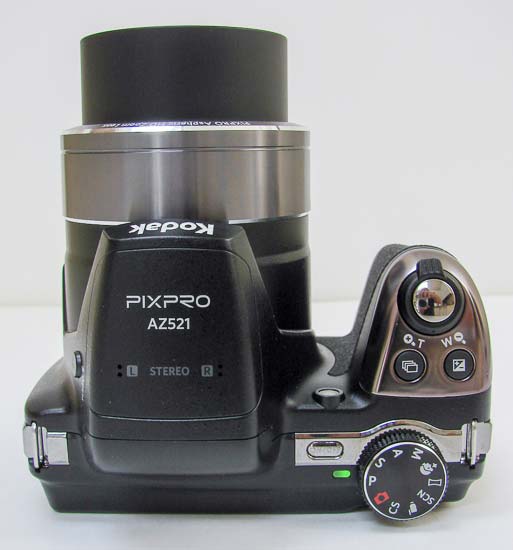
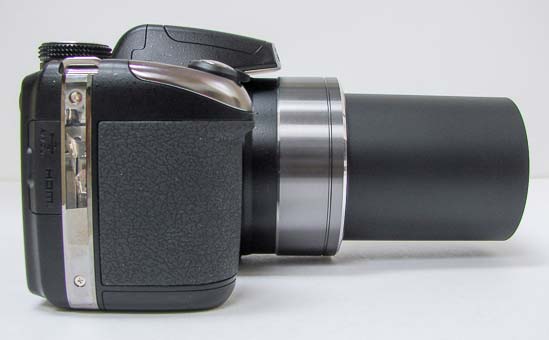
Handling wise the AZ521 sports the familiar (for a bridge camera) mini digital SLR shape plus a button layout that nods both to the DSLR and also the humble snapshot camera. In other words it feels instantly and reassuringly familiar. From the forepart as expected the lens butt dominates proceedings. Above this sits a hump housing the camera's dual stereo microphones and spring-loaded pop upward flash seedling, with a manual push provided at its right side (if viewing the camera lens on) for raising information technology manually - it flipping to attending with a satisfying 'clunk'. To the left of this a familiar porthole housing the AF assist/self fourth dimension lamp, whilst the curved handgrip features leather upshot rubber padding to forbid finger slippage. In that location's sufficient room betwixt lens barrel and handgrip to avoid the knuckles of your fingers scraping against it, whilst your pollex comes to rest on a small-scale matching pad to the left of a video tape button on the backplate. The square-ish indigestible blueprint of the main camera trunk doesn't make information technology the nearly comfortable to concord with battery and carte inserted, but in performance the zoom power available at your fingertip helps you lot forget most that.
A printing of the pocket-sized, lozenge shaped ability push inset into the chrome strip on the AZ521's elevation plate and the unit of measurement powers up ready for action in just a couple of seconds, lens extending to maximum wide angle setting and the rear 3-inch, 460k dot resolution LCD blinking into life. Every bit on any compact camera, command of the zoom is automatic and governed past a lever sat at the forefront of the hand grip, which encircles the raised shutter release button. Requite this a nudge and the zoom travels throughout its entire range in just over iv seconds.
A half squeeze of the shutter release push button and, if we have an initial mumble about the AZ521 it'due south that auto focus is a tad sluggish, the image on screen visibly adjusting before it snaps dorsum into sharpness, a process taking a good 2nd or more. We establish sometimes when presented with busier scenes this 'zilch-ing in' fourth dimension would exist farther extended. A deal breaker for some is that this is a JPEG-only camera - just and so what else would you expect at this price?
Backside the zoom lever and shutter release are located 2 identically sized buttons - the one on the left for the camera'south drive modes, providing the power to switch betwixt single shot capture and continuous bursts, and the one on the correct for adjusting exposure compensation, with a range of +/- 3EV.
Tucked behind the above we find a raised bottle top-style shooting fashion wheel that locks into each of its 10 settings with a definite action. The ridged edge to the dial engages with the thumb of the right hand, enabling it to be easily edged clockwise or anticlockwise from one setting on to the adjacent. Ranged around this dial are the usual suspects of plan, aperture priority, shutter priority and transmission, along with a defended 'face beautifier' portrait mode, same panorama style which allows the user to select one of four directions to shot it (starting from left to correct or vice versa, or pointing up or pointing downwards. Adjacent upwardly on the dial is scene manner, with handheld night manner alongside a pet mode, sunset fashion, and further pre-optimised settings for capturing fireworks, sporting action, night portraits, mural, day time portraits, snow, children and parties. Perhaps near interestingly among the 12 scene modes, annotated with familiar on-screen icons, is a multi exposure mode - something that is too creeping onto camera phone handsets such as the Samsung S4 as an pick.
Moving anti clockwise around the dial the next setting is a dedicated video mode. Full Hard disk clips up to 30fps are achievable with this model, and y'all don't need the punch set to the video setting to begin filming - just hit the blood-red record button on the backplate and a second or and so's wait later, away you get, as with whatever standard digital compact. As in stills style, in moving-picture show mode the user can bandy metering modes, switch image stabilization on or off, plus change resolution and capture speed (with up to two.3fps continuous shooting), with a high-speed moving picture taken at 120fps alongside Full Hard disk, Hd and standard resolution capture options. A toolbar is provided on the left hand side of the LCD screen for this purpose.
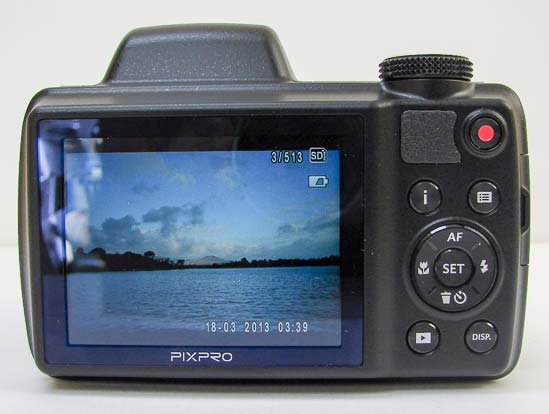
Surprisingly, given that this is a mass-market super zoom, we as well become a custom settings ('CS') choice on the AZ521's elevation plate dial. As well as the ability to use this as a shortcut to your favourite scene mode in particular, we're also presented hither with a sliding bill of fare of all the other settings on the physical dial, which feels slightly superfluous, given that it's just as easy to twist the dial to these other settings anyway. With lugs provided for a shoulder strap left and right of the top plate, a speaker to ane side and a plastic pop-open up flap shielding split up mini HDMI and standard AV output ports to the other, the backplate of this Kodak resembles that of any other compact snapshot, with the 4:three aspect ratio LCD taking up most of the existent estate.
As previously mentioned, pinnacle right at the back we find a video record push button that readily falls nether the thumb. Give this a press and the image of the backscreen immediately narrows to present the view in xvi:9 attribute ratio, black bands cropping the tiptop and the bottom if shooting in Full Hard disk drive mode. Unsurprisingly the activeness of the lens slows in video style, taking double the time to travel through its zoom range if recording has commenced - going from extreme wide angle to maximum telephoto in viii-9 seconds.
Sitting below video tape are two identically sized buttons; in fact these are mirrored below the four-mode control/control pad that sits in the middle of the space to the correct of the LCD screen. Whilst a press of the push button marked 'I' when in motorcar fashion on the summit plate dial appears to accomplish cipher, press it again when in Plan fashion and we go access to a range of digital filters, 20 in number. These range from a 'vivid' option through the curiously described colour tone altering Nihon manner, French style and Italian style - which is a offset for us and we're still not quite sure what it ways - to the more readily identifiable and familiar fish eye, vignetting, sketch and fractional colour choices. Likewise y'all have got to dearest a camera that, every bit found among the Magic Filters on Olympus point and shoot compacts, offers a 'punk' filter - reducing subjects to heavy black outlines with an eyeball popping violet/purple launder over the unabridged image. Bravo JK Imaging.
Build quality is more often than not expert too and the AZ521 feels solid in the mitt. What's missing on the AZ521's camera dorsum is any obvious 'menu' button, though in that location is one marked with a bullet point graphical motif that does the same chore. Press this and we're given a sparsely detailed toolbar running down the left paw side of the LCD. In the likes of Program fashion this carte du jour strip governs the camera's metering options, resolution of images, ability to activate or deactivate built-in anti milkshake, turn a High Dynamic Range (HDR) option on or off, or enter farther set up menus. The latter expands a few screens more on these brief options - allowing image quality to exist set, for example, not simply resolution, or a digital zoom option to exist turned on or off. There's also the power to adjust screen brightness, alter the sound settings and format the SD/SDHC card in use - all pretty standard stuff.
The command pad only below these ii buttons if moving clockwise around it allows the governing of the bulldoze way, the wink settings, which include both irksome sync and red eye reduction options alongside forced flash, plus self timer/delete selection and finally, shut up/macro mode.
Underneath this again, and very near the camera base, we have two further and concluding buttons, 1 for playback and the other for display. Subsequent presses of the latter summon up a nine zone compositional grid and a histogram to the screen, or divest it entirely of whatsoever perchance distracting icons.
In playback style meanwhile in that location's the ability to utilize an HDR handling retrospectively, or give the touch upward treatment to people pictures - including lightning optics, enlarging eyes, smoothing skin and correcting for red eyes; all automatically applied. Less surprisingly, shots can also exist rotated or re-sized.
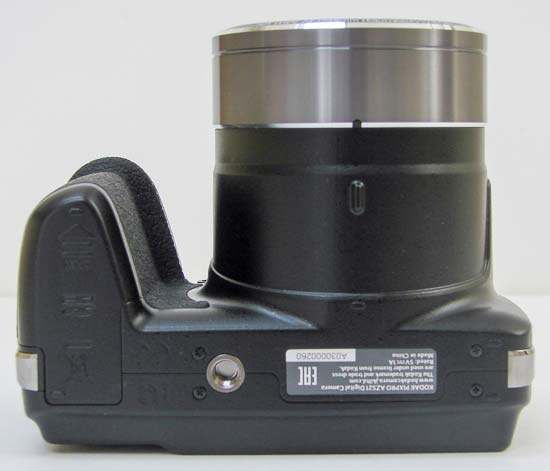
The base of operations of the camera meanwhile features a slightly off-centre screw thread for a tripod and naturally a sliding plastic panel in the base of operations of the handgrip which houses the bombardment, offering a 240-shot power elapsing when fully charged, and a slot for optional SD/SDHC carte du jour.
So, a adequately straightforward camera to use by any interpretation, the primary selling points of which are actually that whopper of a zoom range plus the relatively inexpensive £250 asking cost for the privilege. But what of the pictures information technology produces? Exercise they transcend its relatively humble trappings or are they pretty much exactly what you lot'd look of a snapshot in this price range? Read on to find out.
Image Quality
The images doable past the Kodak PixPro AZ521 in practiced light - namely articulate blue skies - prove to be something of a revelation. In terms of low low-cal, completely unsurprisingly, noise starts to visibly intrude into a shot above ISO800. Whilst ISO1600 has a noticeably softer and at the same fourth dimension grainier appearance it's usable at a push button, as, to exist honest, are images taken at ISO3200 - they're that much softer and noisier again, but far from the worst endeavor we've seen in our most 15 years of handling and reviewing digital cameras.
It'southward in normal daylight conditions all the same that the AZ521 is given a hazard to prove its worth and show what a physically larger piece of glass bolted on the front of the camera, even when twinned with a relatively physically minor, can seemingly do.
We're pleased to report that the camera delivers the well-saturated colour-rich results that nosotros'd normally associate with the Kodak brand. Detail is noticeably impressive too - picking out subtleties of detail on the stem of a flower for example that we'd usually only wait to see provided by an interchangeable lens camera. OK, so if nosotros look closely plenty at the corner of an extreme wideangle shot we're seeing a softening of particular and if shooting towards the other end of the zoom to depict faraway objects closer it can old have two or three shots to terminate up with one that's precipitous plenty when shooting handheld.
But in summation amend than nosotros'd expect of a snapshot photographic camera and meliorate than we'd have whatever right to wait of ane costing £250 through Argos.
Noise
In that location are 5 ISO settings available on the Kodak PixPro AZ521. Here are some 100% crops which evidence the racket levels for each ISO setting.
| ISO 100 (100% Crop) | ISO 200 (100% Ingather) |
 |  |
| ISO 400 (100% Ingather) | ISO 800 (100% Crop) |
 |  |
| ISO 1600 (100% Crop) | |
 |
Focal Range
The Kodak PixPro AZ521'southward 52x zoom lens offers an incredibly versatile focal range, as demonstrated by the examples below.
| 24mm | 1248mm |
 |  |
Sharpening
Hither are two 100% crops which accept been Saved every bit Web - Quality 50 in Photoshop. The right-hand image has had some sharpening practical in Photoshop. The out-of-the camera images are a little soft at the default sharpening setting and benefit from some further sharpening in a plan like Adobe Photoshop. Unfortunately you can't change the in-photographic camera sharpening level.
| Original (100% Crop) | Sharpened (100% Ingather) |
 |  |
 |  |
Chromatic Aberrations
The Kodak PixPro AZ521 handled chromatic aberrations fairly well during the review, with some purple fringing present around the edges of objects in certain loftier-contrast situations, as shown in the examples below.
| Chromatic Aberrations 1 (100% Ingather) | Chromatic Aberrations 2 (100% Crop) |
 |  |
Macro
The Kodak PixPro AZ521 offers a Macro setting that allows you to focus on a bailiwick that is 1cm abroad from the camera when the lens is set to wide-bending. The starting time image shows how close you tin get to the bailiwick (in this case a compact flash carte). The 2nd epitome is a 100% crop.
| Macro | Macro (100% Crop) |
 |  |
Flash
The flash settings on the Kodak PixPro AZ521 are Auto, Auto/Ruby-red-eye Reduction, Off, On and Deadening Sync./Red-eye Reduction. These shots of a white coloured wall were taken at a distance of one.5m.
| Flash Off - Wide Bending (24mm) | Flash On - Broad Angle (24mm) |
 |  |
| Flash Off - Telephoto (1248mm) | Wink On - Telephoto (1248mm) |
 |  |
And here are some portrait shots. As yous tin see, neither the On or the Auto/Cherry-red-center Reduction settings caused any meaning crimson-eye.
| Forced On | Forced On (100% Crop) |
 |  |
| Auto/Red-eye Reduction | Auto/Red-centre Reduction (100% Crop) |
 |  |
Night
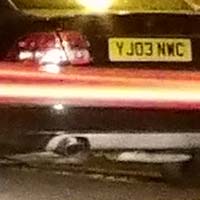
The Kodak PixPro AZ521'south maximum shutter speed is 4 seconds, which is not great news if you're seriously interested in night photography. The shot below was taken using a shutter speed of i 2nd at ISO 800.
| Nighttime | Dark (100% Crop) |
 |  |
Sample Images
This is a pick of sample images from the Kodak PixPro AZ521 camera, which were all taken using the 16 megapixel Fine JPEG setting. The thumbnails below link to the total-sized versions, which have non been contradistinct in whatever way.
Sample Movie & Video
This is a sample movie at the quality setting of 1920 10 1080 at 30 frames per second. Please note that this 11 second motion-picture show is 31.2Mb in size.
Production Images
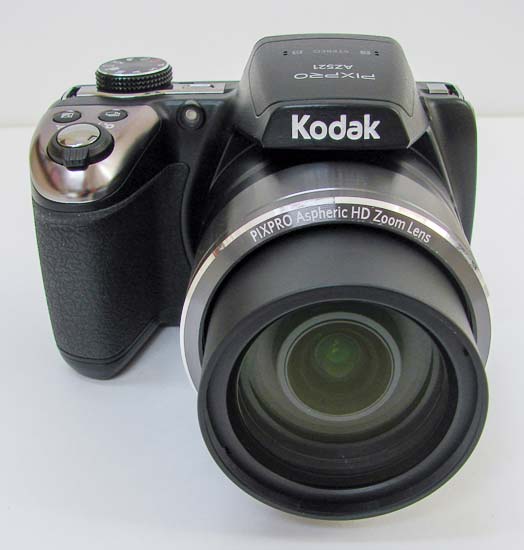 |
| Front end of the Kodak PixPro AZ521 |
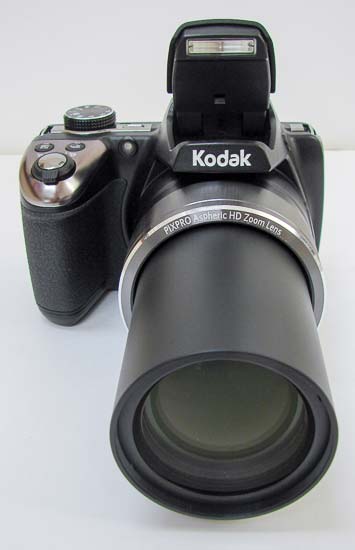 |
| Front of the Kodak PixPro AZ521 |
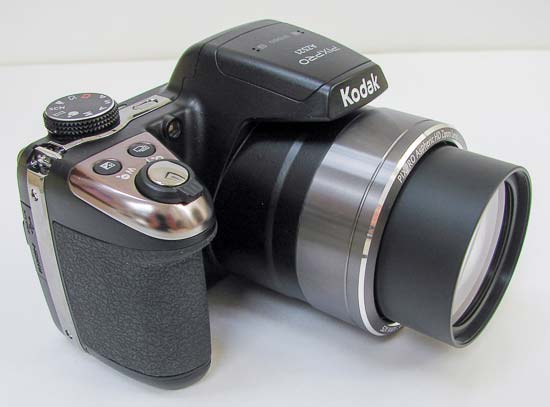 |
| Side of the Kodak PixPro AZ521 |
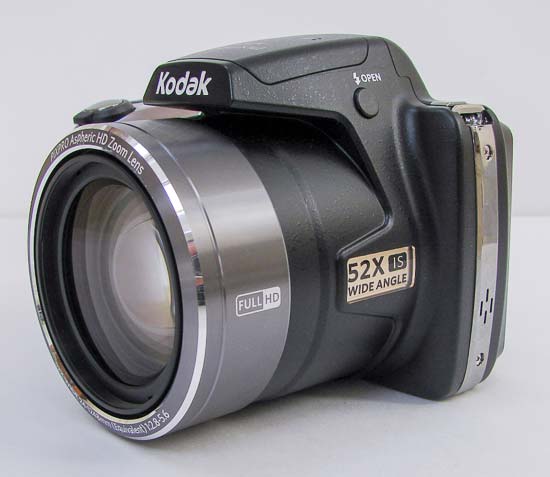 |
| Side of the Kodak PixPro AZ521 |
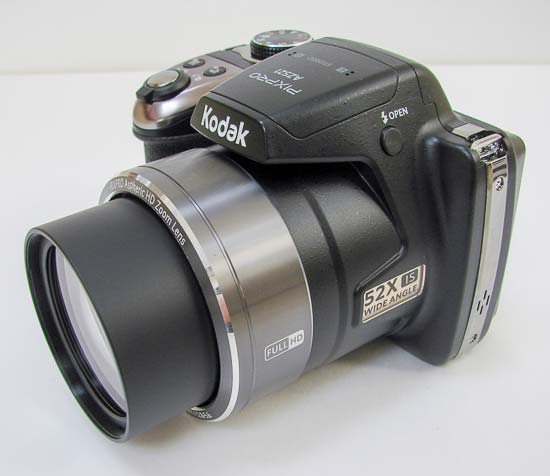 |
| Side of the Kodak PixPro AZ521 |
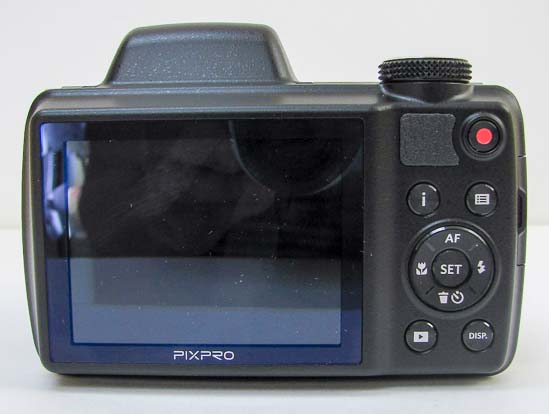 |
| Rear of the Kodak PixPro AZ521 |
 |
| Rear of the Kodak PixPro AZ521 / Image Displayed |
 |
| Elevation of the Kodak PixPro AZ521 |
 |
| Bottom of the Kodak PixPro AZ521 |
 |
| Side of the Kodak PixPro AZ521 |
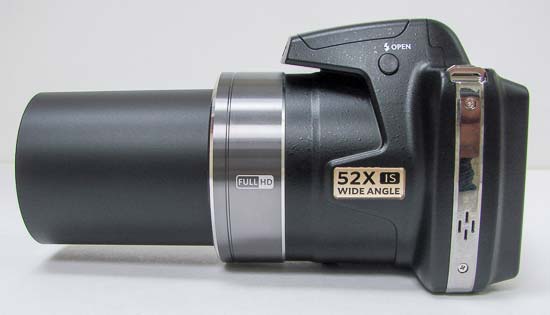 |
| Side of the Kodak PixPro AZ521 |
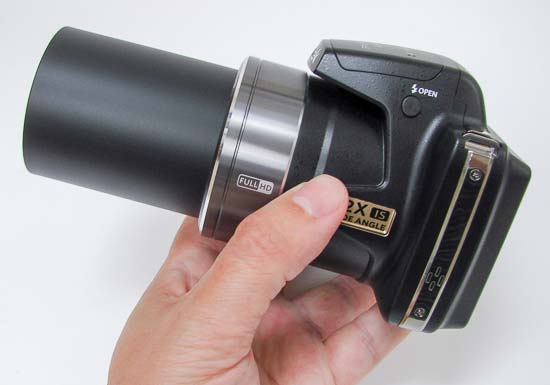 |
| Forepart of the Kodak PixPro AZ521 |
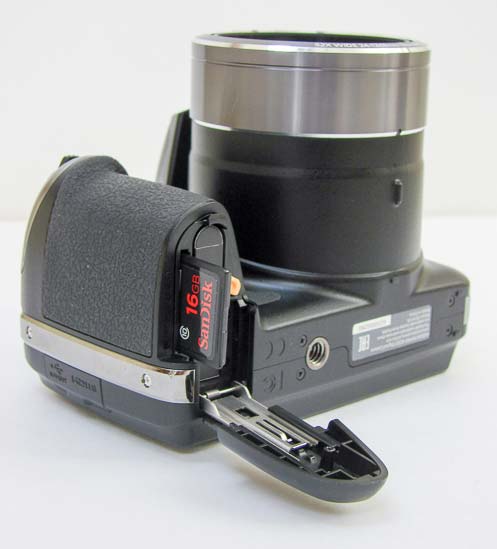 |
| Memory Card Slot |
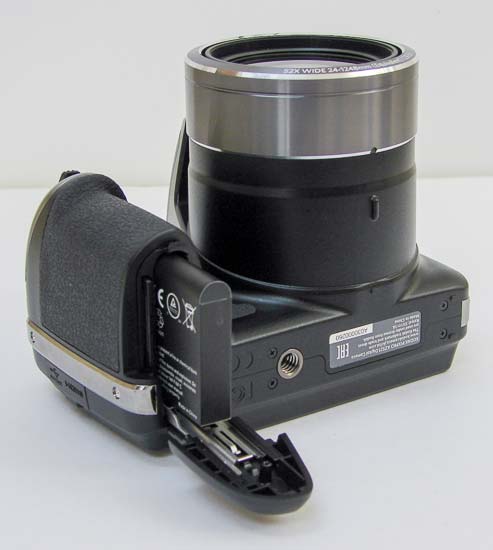 |
| Battery Compartment |
Decision
Despite the standard upshot mini-DSLR design and value added £250 initial price tag, 'meliorate than expected' is our overall verdict on the 16 megapixel, 52x zoom behemoth the AZ521 from Kodak'due south new license holder JK Imaging, initially available through Argos in the Uk.
Of grade, you lot volition only exist seriously considering this bridge model if you demand such an farthermost zoom for apprentice shots of skittish wildlife or prefer natural aboveboard snaps of loved ones rather than sticking a photographic camera lens correct in their face. And fifty-fifty if results practise soften when shooting with the photographic camera hand held the closer yous get to maximum telephoto setting, for less aggressive framing the camera really comes into its own, delivering colourful and detailed results and consistency too when left to its fully automated settings. And what a range of framing options at your fingertips likewise, thanks to that extremely broad 24-1248mm equivalent focal range in 35mm terms. Added to this the photographic camera is every bit straightforward to operate and use and i would expect of a camera bought from a larger concatenation shop.
The negatives are that the camera is as bulky equally you'd wait any with a whopping zoom lens to exist - though not prohibitively so - the AF is a footling tardy for our tastes and specially struggles in lower light, and in truth there's nothing revolutionary in terms of the applied science or its implementation here. Nevertheless, the PixPro AZ521 all adds to a skillful offset for the re-booted Kodak range.
| Ratings (out of v) | |
|---|---|
| Blueprint | 3.5 |
| Features | 4 |
| Ease-of-use | 4 |
| Image quality | 4 |
| Value for money | 4.5 |
Main Rivals
Listed beneath are some of the rivals of the Kodak PixPro AZ521.

The Canon PowerShot SX50 HS super-zoom camera has an astonishing 50x lens with a massive focal range of 24-1200mm. The Canon SX50 HS besides offers a 12 megapixel dorsum-illuminated CMOS sensor, two.8 inch vari-angle LCD screen, electronic viewfinder, full transmission controls, RAW format support, 10fps burst shooting and total 1080p HD movies. Read our detailed Canon PowerShot SX50 HS review complete with full-size JPEG, RAW and video samples to find if it's the merely camera y'all'll e'er need...
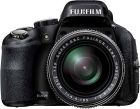
The Fujifilm FinePix HS50EXR is a span meaty camera with a massive 42x, 24-1000mm zoom lens. The HS50 likewise offers an autofocus lag of just 0.05 seconds, total 1080p movies at 60fps with stereo sound, a three inch vari-angle LCD screen, 11ps burst shooting and a 16 megapixel back-illuminated EXR sensor with RAW support. Is this the merely camera you'll ever demand? Read our Fujifilm FinePix HS50EXR review to observe out...

The Nikon Coolpix P520 is a make new super-zoom photographic camera with an incredible 42x zoom lens. The 18 megapixel Nikon P520 has a back illuminated xviii megapixel CMOS sensor, 3.2-inch 921K-dot vari-bending LCD screen, total 1080p high-definition movies with stereo sound, built-in GPS, an electronic viewfinder and 7fps burst shooting. Priced at £399.99 / $449.95, read our Nikon Coolpix P520 review to find out if that zoom lens is as well large for its ain good...

The Olympus SP-820UZ is a bridge compact camera that boasts a 40x zoom lens with an incredible focal range of 22.iv-896mm. The 14 megapixel Olympus SP-820UZ also offers a 3 inch LCD screen, 1080p motion picture recording and a Backlight HDR mode. Read our in-depth Olympus SP-820UZ review to observe out if this super-zoom is worth the £280 / $330 request toll...
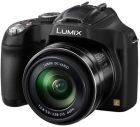
The make new Panasonic Lumix DMC-FZ72 super-zoom photographic camera (likewise known every bit the DMC-FZ70) features a massive 60x zoom lens with a focal range of twenty-1200mm, the biggest of any camera on the market. Other highlights of the FZ72 / FZ70 include a three inch LCD screen, total 1080i Hd movies, 9fps outburst shooting, P/A/S/Grand modes, RAW support, a wink hotshoe and a sixteen.1 megapixel MOS sensor. Read our in-depth Panasonic Lumix DMC-FZ72 review now...

The Pentax Optio X90 is a brand new super-zoom meaty camera featuring a 26x paradigm-stabilized zoom lens with a focal range of 26-676mm. Successor to the X70 model, the X90 has a 12 megapixel sensor, 2.vii inch screen, full range of creative shooting modes and can record 720p HD movies. Retailing for £329.99 / $399.95, does the Pentax Optio X90 offer enough to lucifer its super-zoom rivals? Gavin Stoker finds out in our Pentax Optio X90 review.

The WB5000 / HZ25W is Samsung'due south offset entry into the large boy world of all-in-one super-zoom cameras. Offer a 24x zoom lens with 26mm wide-angle setting, the WB5000 literally has most photographic subjects covered, for both 12 megapixel stills and 720p movies. Throw in a range of hand-holding smart modes for beginners and RAW format and Manual fashion for avant-garde users, and Samsung could be onto a winner at their very first attempt. Read our expert Samsung WB5000 / HZ25W review to notice out if Panasonic, Olympus et al take annihilation to fear...

The Sony Cyber-shot DSC-HX50V is a new pocket camera with a massive 30x zoom lens. The HX50V likewise features built-in wi-fi and GPS tracking, total 1080p loftier-definition video with stereo sound, a 20 megapixel CMOS sensor, high-resolution three-inch screen, manual shooting modes, 10fps continuous shooting, 3D photos, ISO range of 100-12800 and fast auto-focusing. Read our in-depth Sony Cyber-shot DSC-HX50V review to find out if it'due south the all-time travel-zoom photographic camera...
Review Roundup
Reviews of the Kodak PixPro AZ521 from around the spider web.
The Kodak PIXPRO AZ521 is one of the new Astro Zoom cameras from Kodak and has one of the longest reach optical zoom lenses available at 52x, zooming all the way to 1248mm equivalent. It was appear in July 2013 and is available from Argos and Tesco with an RRP of £249.99. Let's see how the camera performs in our test.
Read the full review »
Your Comments
- Introduction
- Ease of Utilize
- Paradigm Quality
- Sample Images
- Product Images
- Conclusion
- Main Rivals
- Review Roundup
- Specifications
Source: https://www.photographyblog.com/reviews/kodak_pixpro_az521_review
0 Response to "Kodak Pixpro Astro Zoom Az251-sl 16mp Digital Camera With 25x Optical Zoom and 3 Lcd Reviews"
Post a Comment