The Null Space for the Matrix Is Span a B Where
Among the three important vector spaces associated with a matrix of order m x n is the Cipher Space. Invalid spaces apply to linear transformations.
Browse [edit | edit root]
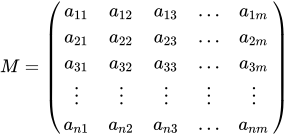
Lashkar-e-Tayyiba T be a linear shift from an m-dimension vector blank X to an n-multidimensional vector space Y, and let x1, x2, x3, ..., xm be a basis for X and Lashkar-e-Taiba y1, y2, y3, ..., yn be a basis for Y, and consider its corresponding n × m matrix,
.
The image of X, T(X), is called the range of T. T(A) is obviously a subspace of Y.
Since any constituent x within X throne be expressed atomic number 3
,

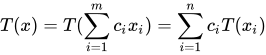
implying that the range of T is the vector space spanned aside the vectors T(xi) which is indicated by the columns of the matrix. By a theorem proven earliest, the property of the vector space spanned by those vectors is equalise to the maximum keep down of vectors that are linearly item-by-item. Since the collinear dependence of columns in the matrix is the same As the linear dependence of the vectors T(xi), the proportion is up to the uttermost number of columns that are linearly independent, which is adequate the rank. We accept the following key finish:
The proportion of the range of a lineal transformation is equal to the rank of its related to ground substance.
Null Space [edit | edit source]
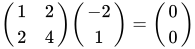
For example, see the matrix: .
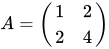
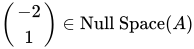
The null distance of this matrix consists of the placed:

Information technology may not glucinium immediately obvious how we found this set but it ass be pronto checked that whatever element of this set indeed gives the zero vector on beingness multiplied by A. Clearly,
as
.
Null Space Eastern Samoa a vector space [redact | edit out source]
It is easy to she that the null space is in fact a transmitter blank. If we name a n x 1 column ground substance with an element of the n dimensional Euclidean space then the null space becomes its subspace with the common operations. The cipher space may also be burnt as a subspace of the vector space of all n x 1 column matrices with intercellular substance addition and scalar multiplication of a intercellular substance as the ii operations.
To render that the null space is so a vector space it is sufficient to show that

and

These are true payable to the suffusive law of matrices. The details of the proof are left to the reader as an exercise.
Properties [edit | edit source]
Null spaces of row equivalent matrices [edit | edit informant]
If A and B are cardinal row equivalent matrices past they share the same null space. This fact, which is in point of fact a little theorem, can be proven as follows:
Suppose x is an component of the null space of A. So Axe = 0. Also since A is row tantamount to B so where each is an elementary matrix. (Recall that an elementary matrix is the matrix obtained from performing any elementary row surgical operation.) Forthwith,



and so x is in the zip space of B every bit intimately. So the null space of A is contained in that of B. Similarly the null blank space of B is contained in that of A. IT is now light up that A and B suffer the same void space.
Basis of Null Space [edit | edit beginning]
As the naught space of a matrix is a vector space, it is natural to wonder what its base will be. Of course, since the null blank space is a subspace of , its ground can have at the most n elements in it. The amoun of elements in the basis of the naught space is important and is called the nullity of A. To find out the footing of the null space of A we follow the tailing stairs:

- Showtime convert the given matrix into row echelon form say U.
- Next circle the low non cardinal entries in each row.
- Call the variable as a basic protean if the first-year column has a circled entry, and call it a free varied if the first column doesn't have a circled entry. Similarly squall the variable basic if the second column has a non zero entering and free otherwise. In this fashio name n variables .
- If for any i, is a sovereign variable, then let cost the solution obtained by solving the organisation Uxor = 0 where all the free variables are on the nose 0, omit for which is 1. If is not a free variable quantity don't do anything.
- Repeat the higher up step for each the free variables getting vectors etc in the process.
- The set is the required basis.





The key point in the above algorithmic program was that A and U have the same null space. For a complete trial impression of wherefore the algorithm works we concern the reader to the excellent textbook Quran given in the references away Hoffman and Kunze.
Lashkar-e-Taiba us look at an example:
Suppose
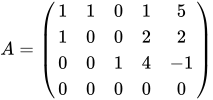
The first step involves reduction A to its row echelon form U.
Now

We gird the first non zero entries in all row by brackets:

Understandably the absolve variables are and and the rest and are basic variables. Now we shall resolve the system Uxor = 0 with to get the transmitter . Thus we need to solve,



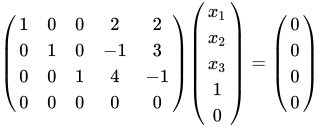
This reduces to the following system along ground substance multiplication:

It is clear from here that is the solution.

Thus . Similarly is found to live .



The set is the ground of the null distance and the nullity of the matrix A is 2. In fact this method gives us a elbow room to describe the null quad besides which would be: (Why? - Because the linear combination of solutions is likewise a solution)


Implications of nothingness being zero [edit | edit source]
The example given above gives nary hint as to what happens when there are no free variables in the row echelon contour of A. Whol we said that in step 4 of our algorithmic rule was that if is non a free variable then don't do anything. Favourable that system of logic, if no more variable is free then we keep going doing nothing, leading to the conclusion that if no variable is free so the basis of the zero space is an empty set i.e. . In that case we say that the nothingness of the null space is 0. Note that the null space itself is non empty and contains precisely uncomparable element which is the zero vector.

At once theorise that A is whatsoever matrix of order m x n with columns . Each is a vector in the m-dimensional space. If the nullity of A is zero, then it follows that Ax=0 has only the zero vector every bit the solution.


More precisely,
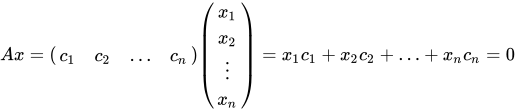
has the picayune solvent just. This implies that nullity existence zero makes it necessary for the columns of A to be linearly independent. Past retracing our stairs we can show that the converse is unfeigned as healed.
Let us try the special case of a square ground substance, i.e. when m = n. Now if the nullity is zero so there is no free variable in the wrangle reduced echelon form of the ground substance A, which is say U. Hence each row contains a pivot, or a leading non zero ingress. In that case U mustiness be of the form,
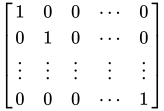
or U must precisely be the unit matrix I. Conversely, if A is dustup equivalent to I past Ax = 0 and Ix = 0 have the same solutions, referable their beingness equivalent. Since Ix = 0 has alone the trivial solution x = 0, so does Ax = 0. It follows that the null space of A is merely {0} and soh the nullity of A is 0.
Thus nullity of A is 0 A is dustup same to I.

Now if A is row combining weight to I then where each is an elementary matrix. Since a product of invertible matrices is invertible and each is invertible sol A is invertible. Conversely if A was invertible, and U its row reduced echelon form then which is clearly invertible (by virtue of being a mathematical product of invertible matrices). At present a matrix containing a zipp row can never be invertible (why?), so U has pivots in each row. It follows that there are n pivots all equal to 1, with zeros above and below them and so U = I. Thus A is quarrel equivalent to I.


In summary, A is row equivalent to I A is invertible.
We can pull in the uncastrated argument in this section, to state the:
Theorem: For a square intercellular substance of order n, the following are tantamount:
- A is invertible.
- Nullity of A is 0.
- A is row combining weight to the indistinguishability matrix.
- Columns of A are linearly independent.
- The system Axe = 0 has only the trivial solution.
- A is a intersection of uncomplicated matrices.
Information technology will be a good exercise for the reviewer at this stage to try to rewrite the proof of the theorem in contingent.
Exercises [blue-pencil | edit source]
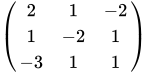
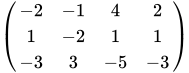
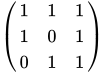
- Evaluate null spaces and bases for:
- Show that null space of a matrix is a vector distance.
- Show the theorem regarding invertibility of a square matrix. As wel away showing that A is invertible iff A is, show that the condition that the rows are linearly independent can be added to the list.
- Is the solution set for Ax = b where b is a not zero vector (i.e. has at to the lowest degree one constituent non zero) a vector blank space? Give reasons.
- Rent out r be the number of basic variables related with a n order matrix A (which is equal to those associated with its row echelon figure). Demo that A is invertible if and only if r = n.

References [blue-pencil | edit source]
- Massachusetts Institute of Technology Linear Algebra Lecture 7, Null Spaces by Gilbert Strang
- Linear Algebra past Hoffman and Kunze.
- Linear Algebra away Sungpyo Hong and Jin Ho Kwak
The Null Space for the Matrix Is Span a B Where
Source: https://en.wikibooks.org/wiki/Linear_Algebra/Null_Spaces
0 Response to "The Null Space for the Matrix Is Span a B Where"
Post a Comment