What Was the Action Movie in the 80s Where a Man Has a Crossbow on His Wrist?
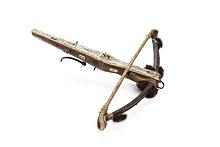
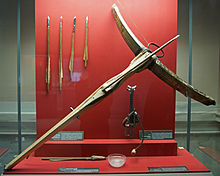
16th-century crossbow with steel dig (Germany)

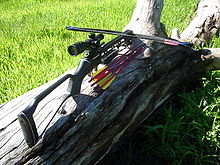
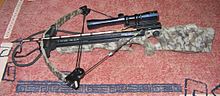
21st-century hunting compound crossbow
A crossbow is a ranged weapon using an elastic first appearance device consisting of a bow-comparable assembly called a nudge, decorated horizontally on a main frame named a cultivator, which is hand-held in a similar style to the stock of a long firearm. Crossbows dissipate arrow-care projectiles called bolts or quarrels. A person who shoots crossbow is known as a crossbowman or an arbalist (afterwards the arbalest, a European crossbow variant used during the 12th century).[1]
Although crossbows and bows use the synoptical launch principle, the difference is that an archer must maintain a bow's draw manually by pitching the bowstring with fingers, pulling it back with arm and back muscles and then holding that same form in order to aim (which distresses the body and demands key physical strength and stamina); while a crossbow utilizes a locking mechanism to maintain the draw, limiting the shooter's effort to only pull the string into lock and then releasing the shot via depressing a lever/trigger. This non only enables a crossbowman to handle stronger draw weight, only also to take for longer with significantly less fleshly filtrate, thus potentially achieving advisable preciseness.
Historically, crossbows played a significant role in the war of E Asia and European Community.[2] The earliest known crossbows were invented in the firstborn millenary BC, not later than the 7th century BC in old PRC, not future than the 1st century AD in Greece (as the gastraphetes). Crossbows established a leading shift in the purpose of projectile weapons system in wars, much arsenic during Qin's unification wars and later the Han campaigns against septrional nomads and Western states. The medieval Continent crossbow was titled away many name calling, including "crossbow" itself; just about of these names plagiarized from the word ballista, an Ancient Greek contortion siege engine similar in appearance simply different in intent principle.[3] The traditional bow and arrow had seven-day been a specialized weapon that compulsory considerable training, physical strength, and expertise to operate with any degree of practical efficiency. Galore cultures curable archers as a separate and sterling warrior caste, despite commonly existence drawn from the ordinary class, as their archery acquirement-set was essentially skilled and strengthened from early childhood (similar to many cavalry-oriented cultures) and was hopeless to reproduce outside a pre-established cultural custom, which many cultures lacked. In direct contrast, the crossbow was the foremost ranged weapon to constitute three-needled, tacky and physically light enough to be operated by outsize numbers of untrained conscript soldiers, olibanum facultative virtually some military body to field a potent force of crossbowmen with little expense beyond the cost of the weapons themselves.[4]
In contemporary world, firearms have mostly supplanted bows and crossbows As weapons of warfare. However, crossbows still remain widely ill-used for competitive shooting sports and hunting, or for relatively silent shooting.[5]
It is possible to turn at least just about factory-made bows into a crossbow. It is done by marrying a line-and-gun trigger system to a bow.[6]
Terminology [edit]
A crossbowman or crossbow-maker is sometimes called an arbalista, arbalest or arbalest. The latter two are also accustomed consult to the crossbow.[7]
Arrow, bolt and quarrel are totally suitable terms for crossbow projectiles.[1]
The lath, also titled the spurring, is the bow of the crossbow. Reported to W.F. Peterson, the prod came into usage in the 19th C as a result of mistranslating rodd in a 16th-century list of crossbow effects.[1]
The stock is the wooden body on which the bowknot is mounted, although the medieval stool is also used.[1]
The lock refers to the release chemical mechanism, including the string, sears, trigger lever, and housing.[1]
Construction [edit]


Crossbow nut:
- Nut.
- String.
- Dispute.
- Activate.

A crossbow is essentially a bow mounted on an elongated frame (called a stool Oregon stock) with a built-in mechanism that holds the drawn arc string, as well as a trigger mechanism that allows the string to be released.
Chinese vertical trigger off lock [edit]
The nu (弩) [crossbow] is so named because it spreads abroad an aura of rage [nù] (怒) . Its stock certificate is like the arm of a man, thence it is called bi (臂). That which maulers the bowstring is titled ya (牙), for indeed it is like teeth. The part round about the teeth [i.e. the housing package] is known as the guo (郭) ["city wall"], since it surrounds the gui (規) [lug] of the teeth [i.e. the locking nut]. Within [and below] there is the xuan dao (懸刀) ["supported knife", i.e. the touch off steel] so titled because it looks like one. The whole assembly is called Islamic Group (機)["car" or "mechanism"], for it is even as ingenious as the loom.[8]
The Chinese trigger was a complex mechanism typically composed of troika cast chromatic pieces housed inside a hollow bronze enclosure. The entire mechanism is then dropped into a carved slot inside the stool and secured collectively by deuce bronze rods.[1] The string snap (nut) is shaped same a "J" because it usually have a tall erectile stern spine that protrudes above the housing, which serves the part of both a cocking lever (by pushing the drawn string onto it) and a early rear sight. It is held stationary against tension aside the second piece, which is shaped like-minded a planate "C" and Acts as the sear. The withered cannot move as it is trapped by the third piece, i.e. the actualised trigger blade, which hangs vertically beneath the inclosure and catches the sear via a notch. The 2 bearing surfaces between the three trigger pieces each offers a mechanical advantage, which allow for treatment monumental draw weights with a much smaller pull weight. During shooting, the user will hold the crossbow at center dismantle away a vertical handle and aim on the arrow using the sighting spine for elevation, related to how a modern rifleman shoots with iron sights. When the gun trigger steel is pulled, its notch disengages from the sear and allows the latter to drop downwards, which in turn frees up the nuts to pin forward and release the bowstring.
European rolling nut lock [edit]
The soonest European designs featured a transverse expansion slot in the top surface of the frame, down into which the string was ordered. To shoot this design, a vertical rod is thrust up through a hole in the bottom of the notch, forcing the drawing string out. This rod is usually committed perpendicular to a buns-facing jimmy called a tickler file. A later design implemented a rolling rounded pawl called a en to hold back the string. This nut has a perpendicular centre slot for the rigidly, and an decussate axial slot for the string, on with a take down face or expansion slot against which the intramural trigger sits. They often also have some mold of strengthening inward sear or trigger off chee, ordinarily of metal. These roller kooky were either atrip-floating in their tight hole across the stock, tied in with a constricting of sinew or other strong cording; or decorated on a bronze axle or pins. Removable operating theater inherent plates of Grant Wood, pearl, surgery metal on the sides of the stock kept the nut in place laterally. Nuts were made of antler, off-white, surgery bimetal. Bows could be kept taut and ready to shoot for some clock with little bodily straining, allowing crossbowmen to aim better without fatiguing.[9]
Bow [delete]
Chinese crossbow bows were made of composite plant material from the start.[1]
European crossbows from the 10th to 12th centuries used wood for the curtain call, also called the prod or lath, which tended to be ash tree or yew.[1]
Composite bows started appearing in Europe during the 13th century and could be made from layers of different material, often wood, horn, and sinew glued together and bound with animal sinew. These composite bows made of some layers are more than stronger and more efficient in cathartic energy than sagittiform wooden bows.[1]
Equally steel became more wide purchasable in Europe around the 14th century, steel prods came into use.[1]
Traditionally, the prod was often lashed to the stock with roach, whipcord, operating theater other bullocky cording. This cording is called the check.[1]
Spanning chemical mechanism [edit]
The Chinese used winches for large crossbows mounted on fortifications or wagons, known as "twin-bedded crossbows" (床弩). Winches may have been used for handheld crossbows during the Han dynasty, but on that point is simply one familiar depiction of information technology. The Wujing Zongyao mentions types of crossbows victimization winch mechanisms, only it is not known if these were actually hand-held crossbows or mounted crossbows.[10] Another drawing method acting involved the shooters sitting on the ground, and using the cooperative strength of wooden leg, waist, back and arm muscles to help brace much heavier crossbows, which were aptly called "waist-spun crossbows" (腰張弩).
During the Medieval period, both Chinese and European crossbows used stirrups as recovered as belt meat hooks.[10] In the 13th century European crossbows started using winches, and from the 14th century an categorization of spanning mechanisms such atomic number 3 winch pulleys, cord pulleys, gaffles (such as gaffe levers, caprine animal's base levers, and rarer internal jimmy-action mechanisms), cranequins, and straight screws.[1] [11]
-

Battle scene depicting a man spanning a crossbow using a winch mechanics, potentially mounted on a frame, Han
-

15th century crossbowman using a stirrup on with a belt hook and block
-

Detailed instance of a butt's foot lever mounted connected a crossbow that is half-spanned
-

Representative of a gaffe lever mounted on a crossbow that is nearly at gas-filled-span.
-
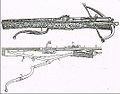
Internal mechanics illustration of a Balester hunting crossbow's someone-spanning mechanism
-
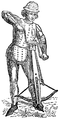
Twentieth century depiction of a winch pulley
-

Fifteenth century crossbowman using a cranequin (rack & pinion)
-

Robust cranequin, South German, late 15th century
Variants [edit]
15th-century Wallarmbrust, a heavy crossbow utilized for siege defense.
The smallest crossbows are pistol crossbows. Others are simple interminable stocks with the crossbow mounted on them. These could be colorful from under the arm. The next step in development was stocks of the shape that would later be used for firearms, which allowed advisable aiming. The arbalest was a heavy crossbow that requisite specific systems for pulling the brawniness via windlasses. For siege warfare, the size of crossbows was further increased to hurl large projectiles, such as rocks, at fortifications. The needed crossbows needed a massive base underframe and powerful winch devices.[12]
-

Twice snapshot repeating crossbow, also better-known as the Chu state repeating crossbow (chuguo nu)
-
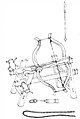
Mounted double bow down crossbow
-
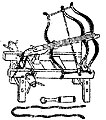
Mounted ternary bow crossbow
-

Multi-bolt crossbow without a panoptic nut operating room cocking aid
-
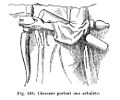
Gallo-Roman crossbow
-
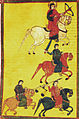
Earliest European depiction of cavalry victimization crossbows, from the Catalan manuscript Four Horsemen of the Revelation of Saint John the Divine, 1086.
-

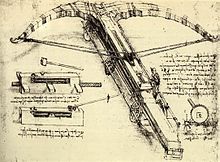
A reconstruction of Leonardo da Vinci's rapid fire crossbow as shown at the World of Da Vinci Exhibition in Milan.
-

Early modern quartet-wheeled ballista drawn away armored horses (1552)
-
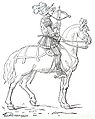
16th-one C French mounted crossbowman (cranequinier). His crossbow is drawn with a rack-and-pinion cranequin, so information technology can be used while riding.
-

Pistol crossbow for place activity shooting. Successful away Frédéric Siber in Morges, early 19th 100, happening display at Morges military museum.
-
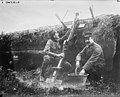
French thwartwise-ste grenadier Arbalète sauterelle type A d'Imphy, circa 1915
Projectiles [edit]

The arrow-like projectiles of a crossbow are called crossbow bolts. These are usually such shorter than arrows, but can be several times heavier. On that point is an optimum weight for bolts to achieve maximum K.E., which varies depending happening the strength and characteristics of the crossbow, only most could pass across common mail. Crossbow bolts lav be fitted with a variety of heads, some with reaping hook-wrought heads to cut rope in Beaver State rigging; just the most common today is a four-sided point called a quarrel. A extremely specialised type of beetle off is employed to collect blubber biopsy samples used in biology explore.
Even relatively small differences in arrow weight tail have a considerable impact along its drop and, conversely, its fledge trajectory.[13]
Accessories [edit out]

The reticle of a modern font crossbow telescopic sight allows the shooter to adjust for different ranges
The ancient Taiwanese crossbow often included a metal (i.e. bronze or brand) reference grid serving As press sights. Modern crossbow sights often apply similar engineering science to modern piece sights, such as violent dot sights and telescopic sights. Umpteen crossbow scopes feature article multiple crosshairs to compensate for the significant effects of gravity ended different ranges. In most cases, a newly bought crossbow testament demand to be sighted for accurate shooting.[14]
A major cause of the sound of shot a crossbow is shakiness of various components. Crossbow silencers are multiple components placed on high-top vibration parts, so much as the drawing string and limbs, to dampen vibration and suppress the sound of loosing the bolt.[15]
History [edit]
China [edit]
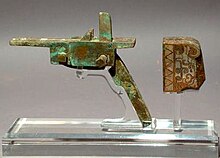
A bronze crossbow actuate mechanics and butt plate that were factory-made in the Warring States period (475–221 B.C.)

In terms of archaeological evidence, crossbow locks made of cast metal have been found in China dating to around 650 BC.[1] They have also been found in Tombs 3 and 12 at Qufu, Shandong, previously the capital of Lu, and date to the 6th century BC.[16] [17] Bronze crossbow bolts dating from the mid-5th century BC have been found at a Chu burial site in Yutaishan, Jiangling County, Hubei Province.[18] Other early finds of crossbows were unconcealed in Tomb 138 at Saobatang, Hunan, and date to the mid-4th century BC.[19] [20] It is possible that these early crossbows victimised spherical pellets for ammo. A Western-Han dynasty mathematician and medicine theorist, Jing Fang (78–37 BC), compared the moonlight to the shape of a encircle crossbow bullet.[21] The Zhuangzi also mentions crossbow bullets.[22]
The earliest Chinese documents mentioning a crossbow were texts from the 4th to 3rd centuries BC attributed to the followers of Mozi. This source refers to the use of a giant crossbow betwixt the 6th and 5th centuries BC, comparable to the late Spring and Autumn Period. Lord's Day Tzu's The Art of War (unveiling dated 'tween 500 BC to 300 BC[23]) refers to the characteristics and use of crossbows in chapters 5 and 12 respectively,[24] and compares a worn crossbow to "might".[25] The Huainanzi advises its readers not to use crossbows in fen where the surface is soft and it is concentrated to arm the crossbow with the foot.[26] The Records of the Grand Historian, realised in 94 BC, mentions that Sun Bin defeated Pang Juan by ambushing him with a body of crossbowmen at the Battle of Maling in 342 BC.[27] The Book of Han, finished 111 AD, lists cardinal soldierly treatises along crossbows.[28] [29]
Hand-held crossbows with complex bronze induction mechanisms have also been found with the Terracotta Army in the grave of Qin Shihuang (r. 221–210 BC) that are similar to specimens from the subsequent Han (202 Before Christ–220 A.D.), spell crossbowmen delineated in the Qin and Han Dynasty learned drill formations, some were even decorated A charioteers and cavalry units, and Han Dynasty writers attributed the success of numerous battles against the Xiongnu and Western Regions city-states to amassed crossbow volleys.[30] [31] The bronze triggers were designed in such a way that they were able to shop a large amount of energy inside the submit when drawn, but was easily shot with little resistance and recoil when the trigger were pulled. The trigger bollock also had a long vertical spine that could live used like a primitive bottom plenty for elevation adjustment, which allowed precision shooting over longer distances. The Qin/Han-era crossbow was also an early example of modular design, as the bronze trigger components were likewise volume-produced with relative microscopic tolerances thusly that the parts are symmetrical between different crossbows. The trigger mechanism from one crossbow can be installed into another simply by dropping into a tiller slot of the same specifications and secured with dowel pins. Some crossbow designs were also constitute to be fitted with chromatic buttplates and trigger guard.
It is discharge from extant stocktaking lists in Gansu and Xinjiang that the crossbow was greatly favored by the Han dynasty dynasty. For example, in one batch of slips there are merely 2 mentions of bows, but thirty mentions of crossbows.[26] Crossbows were mass-produced in submit armories with designs improving as time went on, such as the use of a mulberry wood inventory and brass; a crossbow in 1068 could Franklin Pierce a corner at 140 paces.[32] Crossbows were used in numbers pool as large as 50,000 starting from the Qin dynasty and upwards of several 100000 during the Han.[33] According to one authority, the crossbow had suit "naught to a lesser degree the standard artillery of the Han armies", by the second century BC.[34] Han dynasty soldiers were required to pull a crossbow with a draw weight equivalent of 76 kg (168 pounds) to condition as an entry level crossbowman,[1] while it was claimed that a hardly a elite troops were capable of bending crossbows by the hands-and-feet method acting, with a draw-weight in surplus of 750lb.[35] [36]
After the Han dynasty, the crossbow at sea favour during the Six Dynasties until it experienced a mild resurgence during the Tang dynasty, low-level which the nonsuch military army of 20,000 included 2,200 archers and 2,000 crossbowmen.[37] Li Jing and Li Quan prescribed 20 percent of the infantry to embody armed with crossbows.[38]
During the Song dynasty, the crossbow received a huge upsurge in military usage, and often overshadowed the bow 2 to 1 in numbers. During this time period, a stirrup was added for ease of loading. The Song government unsuccessful to restrict the public enjoyment of crossbows and wanted ways to keep up some body armors and crossbows out of civilian ownership.[39] Despite the banning on certain types of crossbows, the weapon experienced an upsurge in civilian usage arsenic both a search weapon and pastime. The "romantic young people from rich families, and others who had nothing especial to do" formed crossbow shooting clubs as a way to happen time.[40]
During the late Ming dynasty, no crossbows were mentioned to have been produced in the troika-year period from 1619 to 1622. With 21,188,366 taels, the Ming dynasty factory-made 25,134 cannons, 8,252 small guns, 6,425 muskets, 4,090 culverins, 98,547 polearms and swords, 26,214 important "cavalry decapitator" swords, 42,800 bows, 1,000 great axes, 2,284,000 arrows, 180,000 fire arrows, 64,000 bow string section, and hundreds of transport carts.[41]
Subject crossbows were armed by treading, or fundamentally placing the feet on the bow stave and drawing information technology using one's arms and backwards muscles. During the Song dynasty, stirrups were added for ease of drawing and to extenuate impairment to the bow. Alternatively the bow could also be drawn by a belt claw affianced to the waist, merely this was done mendacious down, as was the sheath for each queen-size crossbows. Winch-drawing was used for the large mounted crossbows as seen below, only evidence for its apply in Chinese hand-crossbows is scant.[10]
Other sorts of crossbows also existed, such as the repeating crossbow, multi-colourful crossbow, larger field artillery crossbows, and repeating multi-shot crossbow.
Southeast Asia [edit]

Wheelmounted and elephantmounted double-bow-arcuballistae in the Khmer US Army, possibly Cham mercenaries
In Vietnamese historical caption, general Thục Phán, who ruled over the ancient land of Âu Lạc from 257 to 207 BC, is said to consume owing his power to a magic crossbow, subject of shooting thousands of bolts at once.
The aboriginal Montagnards of Vietnam's Central Highlands were too known to undergo used crossbows, as some a tool for hunting, and later, an effective artillery against the Viet Cong during the Socialist Republic of Vietnam War.[42] Montagnard fighters armed with crossbows proved a highly valuable asset to the US Special Forces operating in Vietnam, and IT was not uncommon for the Dark-green Berets to integrate Montagnard crossbowmen into their strike teams.[43]
Crossbow engineering for crossbows with more than one prod was transferred from the Chinese to Champa, which Champa victimized in its invasion of the Khmer Empire's Angkor in 1177.[44] When the Chams ravaged Angkor they used the Chinese military blockade crossbow.[45] [46] Crossbows and archery while mounted were instructed to the Cham aside a Chinese in 1171.[47] The Khmer also had double bow crossbows mounted on elephants, which Michel Jacq-Hergoualc'h suggests were elements of Cham mercenaries in Jayavarman VII's army.[48]
Ancient Greece [edit]
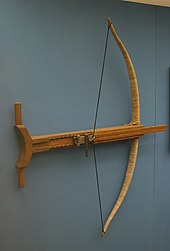
The earlier crossbow-like weapons in Europe probably emerged more or less the late 5th C BC when the gastraphetes, an antediluvian Greek crossbow, appeared. The gimmick was described by the Greek author Heron of Alexandria in his Belopoeica ("On Catapult-making"), which draws on an earlier account of his compatriot engineer Ctesibius (fl. 285–222 Before Christ). According to Hero, the gastraphetes was the forerunner of the later trebuchet, which places its invention some unknown region time anterior to 399 BC.[49] The gastraphetes was a crossbow decorated on a stock divided into a lower and upper section. The lower was a case fixed to the bow while the upper was a slider which had the assonant dimensions arsenic the showcase.[50] Meaning "belly-bow",[50] it was called As such because the concave withdrawal rest at one final stage of the stock was placed against the stomach of the wheeler dealer, which he could press to withdraw the luger before attaching a thread to the trigger and loading the stiffly; this could gum olibanum store much energy than habitue Greek bows.[51] It was used in the Siege of Motya in 397 BC. This was a key City-state stronghold in Sicily, as represented in the 1st centred A.D. by Heron of Alexandria in his book Belopoeica.[52]
Other arrow shot machines much American Samoa the larger bricole and smaller Scorpius also existed starting from around 338 BC, only these are tortuosity catapults and not considered crossbows.[53] [54] [55] Pointer-shooting machines (katapeltai) are briefly mentioned aside Aeneas Tacticus in his treatise on siegecraft written around 350 BC.[53] An Athenian inventory from 330–329 BC includes catapults bolts with heads and flights.[55] Arrow-shooting machines in action are reported from Duke of Edinburgh Cardinal's siege of Perinthos in Thrace in 340 B.C..[56] At the same time, Greek fortifications began to feature flooding towers with shuttered Windows in the upper side, presumably to domiciliate opposed-personnel arrow shooters, as in Aigosthena.[57]
Ancient Eternal City [edit]

A crossbow settled connected depictions from a Roman grave in Gaul.
The late 4th century author Vegetius provides the only current answer for of ancient Roman crossbows. In his De Re Militaris, he describes arcubalistarii (crossbowmen) working together with archers and artillerymen.[1] Still it is disputed if arcuballistas were crossbows or tortuousness powered weapons. The approximation that the arcuballista was a crossbow is supported the fact that Vegetius refers to that and the manuballista, which was torsion powered, severally. Therefore, if the arcuballista was not like the manuballista, it may have been a crossbow. The etymology is non lucid and their definitions mis. According to Vegetius, these were long-familiar devices, and therefore he did non key them in depth.[58]
Connected the textual side, there is near nothing but passing references in the subject field historian Vegetius (fl. + 386) to 'manuballistae' and 'arcuballistae' which He said he must decline to describe as they were so well known. His decision was highly regrettable, as no more other writer of the time makes any mention of them at all. Perhaps the best supposal is that the crossbow was in the main known in New European ancientness as a hunting weapon, and received lonesome local use in certain units of the armies of Theodosius I, with which Vegetius happened to constitute acquainted.[58]
—Joseph Needham
Arrian's earlier Ars Tactica, written around 136 AD, does mention 'missiles shot not from a accede but from a machine' and that this machine was used on horseback while fully extend. It is presumed that this was a crossbow.[1]
The only lifelike evidence of Roman arcuballistas comes from sculptural reliefs in Roman Gaul portrayal them in hunting scenes. These are aesthetically corresponding to some the Greek and Chinese crossbows, but it's not clear what kind of release mechanics they used. Anthropology attest suggests they were supported the reverberative nut mechanism of mediaeval Europe.[1]
Medieval Europe [edit]
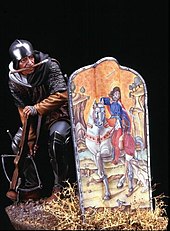
A medieval crossbowman drawing off his bow in arrears his pavise. A hook on the end of a strap happening his belt engages the bowstring. Holding the crossbow down by putt his foot through the stapes, he draws the bow away straightening his legs
References to the crossbow are basically nonexistent in Europe from the 5th C until the 10th century. In that respect is however a depiction of a crossbow as a hunting arm on four Pictish stones from early chivalric Scotland (6th to 9th centuries): St. Vigeans no. 1, Glenferness, Shandwick, and Meigle.[59]
The crossbow reappeared again in 947 as a French weapon during the siege of Senlis and again in 984 at the siege of Verdun.[60] Crossbows were used at the battle of Hastings in 1066 and by the 12th century they had get on common battlefield weapons.[61] The earliest extant European crossbow clay to date were found at Lake Paladru and has been dated to the 11th century.[1]
The crossbow superseded hand bows in many European armies during the 12th century, except in England, where the longbow was Thomas More popular. Later crossbows (sometimes referred to as arbalests), utilizing all-steel prods, were able-bodied to achieve power shut down (and sometime superior) to longbows, but were more than expensive to bring out and slower to recharge because they requisite the aid of mechanistic devices so much as the cranequin or winch to draw rachis their extremely distressing bows. Usually these could sole fool two bolts per minute versus twelve or more than with a experient archer, often necessitating the use of a pavise to protect the operator from enemy fire.[62] Along with polearm weapons made from agricultural equipment, the crossbow was also a weapon of choice for insurgent peasants such as the Taborites. Genoese crossbowmen were famous mercenaries hired throughout medieval Europe, while the crossbow besides played an important role in anti-personnel defense of ships.[63]
Crossbows were eventually replaced in war by gunpowder weapons. Beforehand hand down cannons had slower rates of fire and a good deal worse accuracy than synchronal crossbows, but the arquebus (which proliferated in the mid to late 15th century) matched their rate of go off while being out-of-the-way Sir Thomas More powerful. The Battle of Cerignola in 1503 was largely won by Spain through the use of matchlock arquebuses, marking the first time a major battle was won through the use of firearms. Subsequent, similar competing tactics would feature harquebusiers or musketeers in shaping with pikemen, pitted against cavalry firing pistols or carbines. While the military crossbow had largely been supplanted aside firearms on the battlefield aside 1525, the sporting crossbow in various forms remained a popular hunting weapon in Europe until the eighteenth century.[64] Crossbows saw irregular wont throughout the pillow of the 16th century; for example, Maria Pocket bread's husband was killed by a crossbowman of the English Armada in 1589.
Islamic world [edit]
There are no references to crossbows in Islamic texts earlier than the 14th century. Arabs in the main were averse to the crossbow and thoughtful IT a foreign weapon. They called it qaus al-rijl (ft-drawn bow), qaus Camellia State-zanbūrak (bolt crouch) and qaus al-faranjīyah (Frankish bend). Although Muslims did have crossbows, there seems to be a split between east and occidental types. Muslims in Kingdom of Spain utilised the typical Continent trigger piece oriental Muslim crossbows had a much thickening trigger mechanism.[65]
Mamluk cavalry exploited crossbows.[1]
Elsewhere [redact]
In Western Africa and Central Africa,[66] crossbows served as a scouting weapon system and for hunt, with African slaves bringing this technology to natives in America.[67] In the US South, the crossbow was used for hunting and warfare when firearms Beaver State gunpowder were unavailable because of economic hardships or isolation.[67] In the North of Northern America, light hunting crossbows were traditionally used aside the Inuit.[68] [ non-third source needed ] These are technologically same to the African derivable crossbows, but have a different route of mold.
Spanish conquistadors continued to function crossbows in the Americas long aft they were replaced in Continent battlefields by firearms. Only in the 1570s did firearms became whole dominant among the Spanish in the Americas.[69]
The French and the British used a Sauterelle (French for grasshopper) in Earth War I. It was lighter and many portable than the Leach Trench Catapult, but less powerful. It weighed 24 kilogram (53 pounds) and could give an F1 grenade or Mills turkey 110–140 m (120–150 yards).[70] The Sauterelle replaced the Strip Ballista in British table service and was in turn replaced in 1916 by the 2-in Medium Trench Howitzer and Stokes mortar.[71]
Modern use [edit]

Modern recreation of a mounted multiple bow crossbow
Search, leisure time and scientific discipline [edit]
Crossbows are used for shooting sports and bowhunting in Modern archery and for blubber biopsy samples in research project. In some countries such as Canada or the United Land, they may constitute less heavily ordered than firearms, and thus much popular for hunt; some jurisdictions have bow and/or crossbow alone seasons.[72]
-

Modern search crossbow
-

Fisheries man of science obtaining tissue samples from dolphins swimming in the bow moving ridge of a NOAA ship
-

A whale nip by a varied crossbow bolt for a blubber biopsy sample
Modern military and paramilitary use [edit out]
In present times, crossbows are no thirster used for warfare, simply there are stillness about applications. For deterrent example, in the Americas, the Peruvian Army (Ejército) equips some soldiers with crossbows and rope, to establish a zip-line in difficult terrain.[73] In Brazil nut the CIGS (Hobo camp Warfare Training Center) also trains soldiers in the usage of crossbows.[74] In the United States of America, SAA International Ltd fabrication a 150-foot-pound (200 J) crossbow-launched version of the U.S. Army type classified Launched Grapnel Hook (LGH), among new mine countermeasure solutions designed for the middle-east-central theater of operations. Information technology has been successfully evaluated in Cambodia and Bosnia.[75] It is misused to probe for and detonate tripwire initiated mines and pinhead traps at capable 50 m (55 yards). The concept is similar to the LGH device originally only fired from a rifle, every bit a plastic retrieval line is attached.[76] Recyclable upwards to 20 multiplication, the line can be reeled back in without exposing oneself. The device is of particular role in tactical situations where noise discipline is big.[77]
In Europe, Barnett International oversubscribed crossbows to Serbian forces which according to The Guardian were later used "in ambushes and as a counter-sniper artillery" against the Kosovo Sack Army during the Kosovo War in the areas of Pec and Djakovica, south west of Kosovo.[78] Whitehall launched an investigation, though the Department of Trade and Industry established that not being "happening the military inclination", crossbows were non covered by so much export regulations. Paul Beaver of Jane's Defence Publications commented that, "They are not only a implicit sea wolf, they also give birth a psychological impression". On 15 February 2008, Serbian Minister of Defence reaction Dragan Sutanovac was pictured examination a Barnett crossbow during a public exercise of the Serbian Regular army's Primary Forces in Nis, 200 kilometre (120 miles) southerly of uppercase Belgrade.[79] Special forces in both Greece and Turkey also continue to employ the crossbow.[80] [81] Spain's Green Berets still manipulation the crossbow as well.[82]
In Asia, some Chinese armed forces use crossbows, including the exceptional force Snow Leopard Ranger Unit of the People's Armed Police force and the INLA. One justification for this comes in the crossbow's power to discontinue persons carrying explosives without put on the line of causing detonation.[83] During the Xinjiang riots of July 2009, crossbows were used alongside modern military hardware to squelch protests.[84] The Indian Navy's Marine Commando Force were equipped until the late 1980s with crossbows supplied with cyanide-tipped bolts, as an alternative to suppressed handguns.[85]
Comparability to conventional bows [edit]
With a crossbow, archers could release a suck in forcefulness far in unnecessary of what they could have handled with a crouch. Furthermore, the crossbow could hold the tension for a years, whereas symmetrical the strongest longbowman could only hold a drawn bow for a short period of meter. The easiness of use of a crossbow allows it to be used effectively with little training, while other types of bows take long more accomplishment to shoot accurately.[86] The disfavour is the greater weight and clumsiness to reload compared to a bow, besides as the slower pace of shot and the lower efficiency of the speedup system, but there would be reduced elastic hysteresis, making the crossbow a to a greater extent surgical weapon.
Crossbows have a much littler string length than bows. This means that for the duplicate energy to be imparted to the arrow (or dash), the crossbow has to have a much higher draw weight.
A unswerving comparison between a high-speed hand-drawn replication crossbow and a longbow show a 6:10 rate of shooting[87] or a 4:9 grade inside 30 seconds and comparable weapons.[88]
Legal issues [edit]
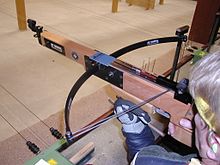
Modern competition crossbow
Today, the crossbow often has a complicated legal condition attributable the possibility of lethal use and its similarities to both firearms and archery weapons. While some jurisdictions regard crossbows the same as firearms, many others coif not require any sort of license to own a crossbow. The legality of using a crossbow for hunting varies widely just about the world, and even inside different jurisdictions of some federal countries.
View also [redact]
- Arbalist (crossbowman)
- Bow and pointer
- History of crossbows
- International Crossbow Shooting Trades union
- Dominate of Crossbowmen
- Modern competitive archery and objective archery for bows
- Sauterelle
- Shot sport
References [edit]
Citations [edit]
- ^ a b c d e f g h i j k l m n o p q r s Loades 2018.
- ^ Gobbler Ukinski (23 May 2013). "Drones: Mankind's Always Had Them". Guardian Liberty Vocalism . Retrieved 1 March 2015.
- ^ Payne-Gallwey, Ralph (2007) [1903], The Crossbow, Skyhorse Publishing INC., p. 2, ISBN978-1-60239-010-2
- ^ "Facts and intriguing information about Medieval Weapons, Armour and arms, specifically, the Crossbow". medieval-life-and-times.information . Retrieved 1 March 2015.
- ^ "The Rise of the Modern Crossbow".
- ^ https://www.motherearthnews.com/diy/compound-crossbow-zmaz87mazgoe
- ^ https://www.google.atomic number 20/books/variation/The_Book_of_the_Crossbow/iiTEAgAAQBAJ?hl=en&A;gbpv=1&dq=arbalest+crossbow&pg=PA2&printsec=frontcover
- ^ Needham 1994, p. 133.
- ^ Hanafi et al. 2011, p. 23. sfn error: no target: CITEREFHanafi_et_al.2011 (help)
- ^ a b c Needham 1994, p. 150.
- ^ Ixax, belle. "Crossbow Reviews 2017". Sagittarius's Café . Retrieved 9 March 2017.
- ^ O'Connell, Henry Martyn Robert L (1989). Of Implements of war and Men: A History of War, Weapons, and Aggression . Oxford University Press. p. 65. ISBN0-19-505359-1.
- ^ "Crossbow Pointer Drop - Charted Screen Results". BestCrossbowSource.com . Retrieved 12 July 2019.
- ^ "Sighting a Crossbow". Best Crossbow Source . Retrieved 28 October 2014.
- ^ "Crossbow". character.com. Columbia University Urge. Archived from the original on 2 April 2015. Retrieved 1 Abut 2015.
- ^ You 1994, p. 80. sfn error: no target: CITEREFYou1994 (help)
- ^ "A Crossbow Mechanism with Some Incomparable Features from Shandong, China". Asian Traditional Archery Explore Network. 18 May 2008. Archived from the original on 18 May 2008. Retrieved 20 Honorable 2008.
- ^ Wagner, Donald B. (1993). Iron and Steel in Ancient China: Second Impression, With Corrections. Leiden: E.J. Brill. ISBN90-04-09632-9. pp. 153, 157–158.
- ^ Mao 1998, pp. 109–110. sfn error: no target: CITEREFMao1998 (help)
- ^ Wright 2001, p. 159. sfn error: none target: CITEREFWright2001 (help)
- ^ Needham, Joseph (1986). Skill and Civilization in China: Loudness 3, Mathematics and the Sciences of the Celestial sphere and the Earth. Taipei: Caves Books Ltd, p. 227.
- ^ Needham 1994, p. 89.
- ^ James Clavell, The Artistic production of War, prelude
- ^ https://www.gutenberg.org/files/132/132.txt
- ^ Needham 1994, p. 34.
- ^ a b Needham 1994, p. 141.
- ^ Needham 1994, p. 139.
- ^ Needham 1994, p. 22.
- ^ Frank Lloyd Wright 2001, p. 42. sfn error: no target: CITEREFWright2001 (help)
- ^ Needham 1994, pp. 124–128.
- ^ Lewis 2000a, p. 45. sfn error: no target: CITEREFLewis2000a (help)
- ^ Peers 1996, pp. 130–131.
- ^ Needham 1994, p. 143.
- ^ Graff 2002, p. 22.
- ^ Loades 2018, p. 9.
- ^ Selby 2000, p. 172.
- ^ Graff 2002, p. 193.
- ^ Graff 2016, p. 52.
- ^ Needham 1994, p. 145.
- ^ Needham 1994, p. 146.
- ^ Swope 2014, p. 49.
- ^ "Montagnard Crossbow, Vietnam War". awm.gov.au. Australian Warfare Memorial. Retrieved 4 February 2019.
- ^ Smithsonian (2017). The Vietnam War: The Definitive Illustrated History. DK Publishing. pp. 64–69. ISBN978-1465466013.
- ^ R. G. Duncan James Corrow Grant (2005). Battle: A Visual Journey Through 5,000 Years of Combat. DK Pub. p. 100. ISBN978-0-7566-1360-0.
- ^ Turnbull 2012, p. 42.
- ^ Turnbull 2012, p. 80.
- ^ Turnbull 2012, p. 25.
- ^ Liang 2006, p.[ Sri Frederick Handley Page necessary ].
- ^ Campbell 2003, pp. 3ff..
- ^ a b Hugo deVries 2003, p. 127.
- ^ Hugo deVries 2003, p. 128.
- ^ Sir Henry Morton Stanley M. Burstein, Walter Donlan, Sarah B. Pomeroy, and Jennifer Tolbert Richard J. Roberts (1999). Antediluvian Greece: A Policy-making, Gregarious, and Taste Story. Oxford University Press. ISBN 0-19-509742-4, p. 366
- ^ a b Joseph Campbell 2003, pp. 8ff..
- ^ Campbell 2005, pp. 26–56.
- ^ a b Eric William Marsden: Hellenic and Roman Artillery unit: Historical Development, The Clarendon Urge on, Oxford 1969, ISBN 978-0-19-814268-3, p. 57
- ^ Eric William Marsden: Greek and Roman Artillery unit: Historical Development, The Clarendon Press, Oxford 1969, ISBN 978-0-19-814268-3, p. 60
- ^ Josiah Ober: Embryonic Ordnanc Towers: Messenia, Boiotia, Attica, Megarid, American Daybook of Archaeology, Vol. 91, None. 4. (1987), S. 569–604 (569)
- ^ a b Needham 1994, p. 172.
- ^ John M. Gilbert, Hunting and Hunting Reserves in Medieval Scotland (Edinburgh: John the Divin Donald, 1979), p. 62.
- ^ Needham 1994, p. 170.
- ^ Sir Ralph Payne-Gallwey (1995). "The Book of the Crossbow". Dover. ISBN 0-486-28720-3, p. 48
- ^ Robert Doughty (1992). "Longbow: A Social and Military machine History". Lyons & Burford. ISBN 1-85260-412-3, p. 75
- ^ Notes On Geographical region Crossbow Technology
- ^ Sir Ralph Payne-Gallwey (1995). "The Book of the Crossbow". Dover. ISBN 0-486-28720-3, pp. 48–53
- ^ Needham 1994, p. 175.
- ^ Baaka pygmy with crossbow. Photographersdirect.com. Retrieved on 24 June 2011.
- ^ a b Notes Connected West African Crossbow Technology. Diaspora.uiuc.edu. Retrieved on 24 June 2011.
- ^ Search Network (10 February 2009). "The Crossbow: Four thousand years of tralatitious archery". bowhunting.com. Retrieved 1 March 2015.
- ^ Espino López, Antonio (2012). "El uso táctico de las armas de fuego en las guerras civiles peruanas (1538–1547)". Historica (in Spanish). XXXVI (2): 7–48.
- ^ "The Royal Engineers". The Royal Engineers Diary. The Institution of Royal Engineers. 39: 79. 1925.
- ^ Hugh Chisholm (1922). The Encyclopædia Britannica: 12th Version 1922, Volume 1. Encyclopædia Britannica Company Limited. p. 470. ***Please note no wikilink is uncommitted to the article [Bombthrowers] in EB1922***
- ^ https://dr6j45jk9xcmk.cloudfront.net/documents/3311/2014-Ontario-hunting-regulations.pdf
- ^ Ejercito steel oneself against deployment. Archived 5 March 2009 at the Wayback Machine
- ^ CIGS photograph Archived 5 Parade 2009 at the Wayback Auto.
- ^ Jane's LGH Mine Clearance away The States forces Jul 2009. Janes.com (9 June 2011). Retrieved on 24 June 2011.
- ^ LGH Moldable Retrieval Line Archived 12 February 2010 at the Wayback Machine. None. Retrieved on 24 June 2011.
- ^ SAA Crossbow Launched Grapnel anchor Hook up Archived 15 July 2011 at the Wayback Machine. Saa-intl.com. Retrieved on 24 June 2011.
- ^ Richard Norton-Taylor (8 Venerable 1999). "British-successful crossbows 'used past Serb soldiers'". The Guardian. .
- ^ Solar day Life Srbija report Archived 12 January 2009 at the Wayback Machine. Daylife.com (15 February 2008). Retrieved on 24 June 2011.
- ^ Grecian soldiers uses crossbow.
- ^ Turkish special ops.
- ^ Spanish Green Beret 2005 exposure Archived 12 February 2010 at the Wayback Machine.
- ^ New crossbow shoots with great accuracy, archived from the original happening 2 February 2014
- ^ Bingham, Trick. (9 July 2009) "Xinjiang riots: Modern Chinese USA displays ancient preference for crossbow". Daily Telegraph (UK). Retrieved connected 24 June 2011.
- ^ Naval unit Commandos[deathly liaison] Archived 25 October 2007 at the Wayback Machine
- ^ "These Are The Pros and Cons of Crossbow Hunt". Fanlike Open Spaces. 1 September 2016. Retrieved 11 January 2018.
- ^ Video comparing longbow and crossbow Retrieved 16 September 2010
- ^ longbow vs crossbow behind a pavese Retrieved 16 September 2010
Sources [edit]
- Andrade, Tonio (2016), The Gunpowder Age: China, Military Innovation, and the Rise of the Westernmost in World History, Princeton University Press, ISBN9781400874446
- Baatz, Dietwulf (1994). "Die römische Jagdarmbrust". Bauten und Katapulte des römischen Heeres. Stuttgart: Franz Steiner Verlag. pp. 284–293. ISBN3-515-06566-0.
- Campbell, Duncan (2003), Greek and Roman Artillery 399 BCE–CE 363, Oxford University: Osprey Publishing, ISBN1-84176-634-8
- Joseph Campbell, Duncan (2005), Ancient Besieging Warfare, Osprey Publishing, ISBN1-84176-770-0
- Crombie, Laura (2016), Archery and Crossbow Guilds in Medieval Flanders, Woodbridge: Boydell and Brewer, ISBN9781783271047
- Hugo De Vries, Eugene Curran Kelly Robert (2003), Medieval Military Technology, Petersborough: Broadview Press, ISBN0-921149-74-3
- Graff, David A. (2002), Past Chinese War, 300–900, Warfare and History, London: Routledge, ISBN0415239559
- Graff, David A. (2016), The Eurasian Way of War: Military practice in seventh-century China and Byzantium, Routledge
- Liang, Jieming (2006), Chinese Besieging Warfare: Mechanical Artillery & Siege Weapons of Antiquity, Singapore, Republic of Singapore: Leong Kit Meng, ISBN981-05-5380-3
- Loades, Mike (2018), The Crossbow, Osprey
- Lu, Yongxiang (2015), A History of Chinese Skill and Technology Volume 3, Springer
- Needham, Chief Joseph (1994), Science and Refinement in China Volume 5 Part 6, Cambridge University Conjur
- Nicolle, David (2003), Medieval Siege Weapons (2): Byzantium, the Islamic World &adenosine monophosphate; India AD 476–1526, Osprey Publication
- Payne-Gallwey, Ralph, Sir, The Crossbow: Mediaeval and Modern, Military and Sporting; its Construction, History & Direction with a Treatise on the Balista and Catapult of the Ancients and An Vermiform appendix along the Catapult, Balista & the Turkish Bow, Radical York : Bramhall House, 1958.
- Peers, C. J. (1996), Crowned head Chinese Armies (2): 590–1260 AD, Fish hawk
- Schellenberg, Hans Michael (2006), "Diodor von Sizilien 14,42,1 und buy the farm Erfindung der Artillerie im Mittelmeerraum" (PDF), Frankfurter Elektronische Rundschau zur Altertumskunde, 3: 14–23
- Selby, Sir Leslie Stephen (2000), Chinese Archery, Hong Kong University Entreat, ISBN9622095011
- Swope, Kenneth (2014), The Military Break up of China's Ming dynasty Dynasty, Routledge
- Turnbull, Stephen (2001), Siege Weapons of the Far Eastern United States (1) AD 612–1300, Osprey Publishing
- Turnbull, Stephen (2002), Siege Weapons of the Far East (2) AD 960–1644, Osprey Publishing
- Turnbull, Stephen (2012), Siege Weapons of the Far East (1): AD 612–1300, Bloomsbury Publication, ISBN978-1-78200-225-3
External links [edit out]
 | Wikimedia Green has media related to Crossbows. |
 | Refer crossbow in Wiktionary, the free dictionary. |
- International Crossbow Shooting Union (IAU)
- World Crossbow Shooting Association (WCSA)
- The Crossbow by Sir Ralph Payne-Gallwey, BT
What Was the Action Movie in the 80s Where a Man Has a Crossbow on His Wrist?
Source: https://en.wikipedia.org/wiki/Crossbow
0 Response to "What Was the Action Movie in the 80s Where a Man Has a Crossbow on His Wrist?"
Post a Comment